


You are handed a single email address. That’s the whole brief.
Everything that would make a message to this person land — who they are, what they’re under pressure to fix this quarter, why they’d ever reply to a stranger — none of it arrives with the address. You have to manufacture all of it.
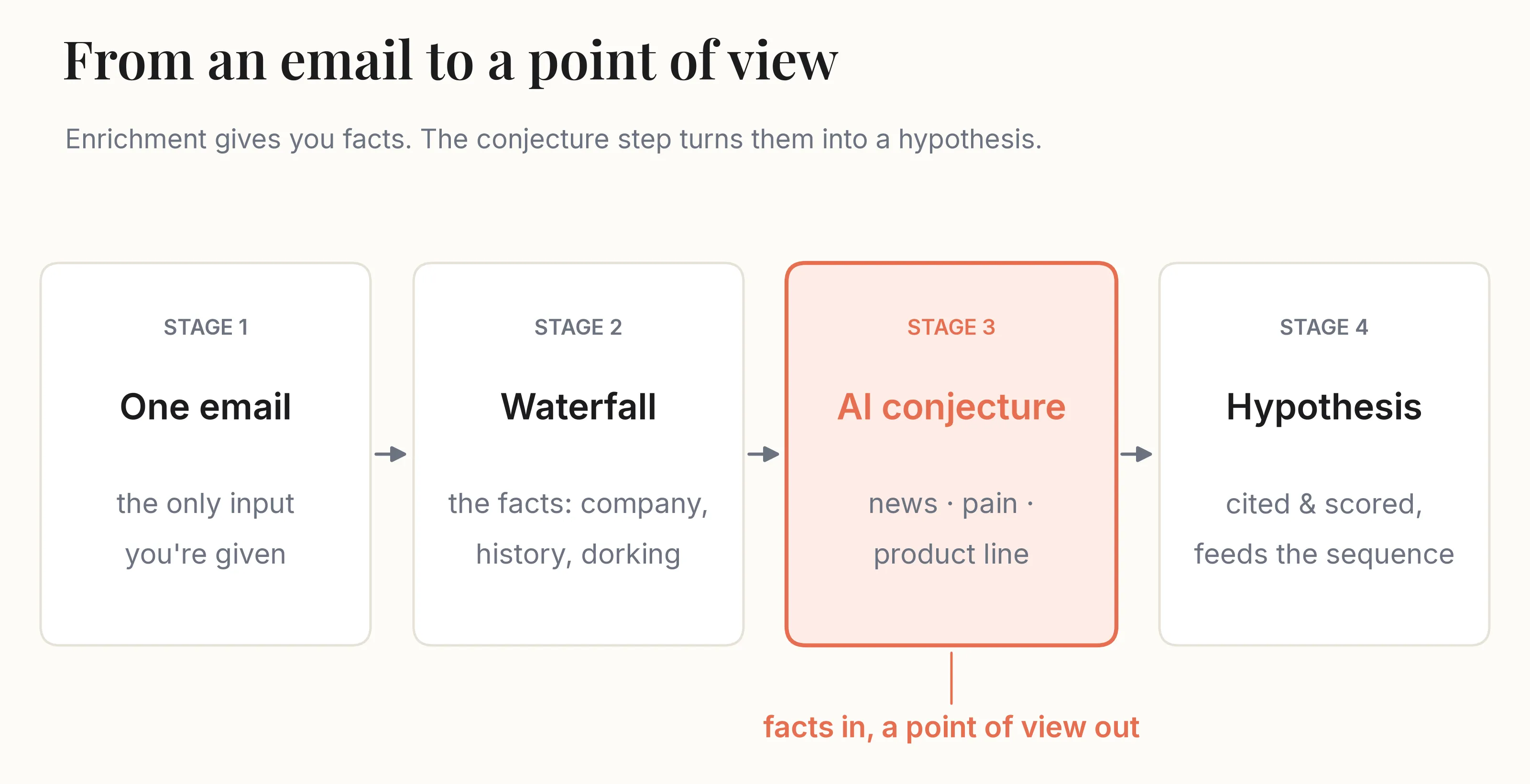
Most outbound stops at the easy half. Point a tool like Clay at that address and it will waterfall its way outward: the email resolves to a company, the company to a person, the person to a LinkedIn, a work history, a scattering of search results. That’s genuinely useful, and it’s also completely commoditized. Everyone has the same facts. Facts have never been why anyone replies.
The half that decides whether outreach works — and the half almost everyone skips — is turning those facts into a hypothesis about what this specific person, in this specific seat, cares about right now.
The waterfall gets you facts
The first stage is mechanical, and each step only becomes possible once the last one lands. From the email you find the company; from the company and a name you find the LinkedIn; from the profile you get a work history; and only then can you go hunting the open web for the things people actually reveal themselves through:
- Interviews, podcasts, and conference talks
- Press quotes and bylined articles
- YouTube appearances where they talk shop
- Targeted search operators (“dorking”) to surface the pages generic search buries
This is a solved problem. It’s plumbing, and the tooling is good. Treat it as table stakes and move on — because a pile of true facts about someone is not the same as knowing what matters to them.
Facts aren’t relevance
“VP of Brand at a mid-market CPG company” tells you what someone is. It tells you nothing about what they’re thinking about. Two people with that identical title can be living in different worlds this quarter — one is firefighting a supply problem, the other is betting their year on a new-market launch. A title is a category; relevance is a moment.
Mail-merging the category is exactly what makes cold outreach feel like being processed by a database. “I saw you’re VP of Brand at Acme” is not personalization. It’s proof you ran a query.
A waterfall turns an email into a company, a title, a work history, a pile of links. It's commoditized, and it only ever tells you what someone is — not what they're weighing this quarter. Merge it into a template and you sound like the database you pulled it from.
An AI step reads the same raw signals and forms a point of view: the news this person actually cares about, the pain they're probably under, the product line that's genuinely theirs. A specific, defensible guess you can open a real conversation with.
The conjecture layer
Here’s the experimental step, and it’s the whole point of the system. After the waterfall, an AI layer reads everything — the history, the current title, the industry, the interviews, the news — and does the one thing enrichment can’t: it forms an opinion. Three of them, specifically.
Three inferences from the same pile of facts
Each is a guess — a considered one — not a lookup
Of every recent signal about their company, industry, and history, which few would THIS person, in THIS role, actually act on? Not 'recent news' — the subset that reaches their desk.
Given their role, company, industry, and that news, what pressures are they likely under? The read a sharp rep makes in the parking lot before a meeting.
Which specific, often country-localized, product line do they actually own — not the global portfolio, but the SKUs they're measured on.
That last one is subtler than it looks. A brand manager for a multinational’s baby-nutrition line doesn’t own “the portfolio” — they own the line for their market, which in many companies is a distinct product with its own name, formula, and P&L per country. Infer that, and your outreach is suddenly about their actual job rather than their employer’s logo. Get it wrong and you’ve proven you didn’t look.
Aim for plausible, not true
The instinct is to recoil from a machine guessing about a real person. But personalization has always been guessing. A good salesperson who spends five minutes on someone’s LinkedIn before a call isn’t certain of anything — they’ve built a working model, and they walk in prepared to be corrected. That’s the target here, encoded at scale.
The bar for an opening line was never “verified fact.” It’s “specific enough that they think this person actually gets my world, and plausible enough to be worth a reply.” A thoughtful wrong guess — “figured the new EU packaging rules might be eating your Q3, are they?” — invites a correction, and a correction is a conversation. A safe generic line invites nothing at all.
Keep the conjecture honest
Guessing at scale is one confident hallucination away from a disaster, so every inference has to carry its receipts. Hand a model a pile of search results and it will happily assert its guesses as facts. The fix isn’t to stop guessing — it’s to make the guess structured and self-aware.
In the payload, an inferred pain point isn’t a sentence. It’s a claim with a paper trail: the evidence it rests on, where that evidence came from, whether it’s stated or inferred, and how confident the model is.
evidence_level is the field that does the real work: it forces the system to distinguish what the prospect said from what the model decided, so a guess never gets phrased downstream as private knowledge. confidence gives you a dial — set a floor, and anything below it gets dropped rather than shipped as a confident lie. Observed facts and inferred claims live in separate fields precisely so a human, or the next model in the chain, can always see where the data ends and the speculation begins.
Insightful, not creepy
Inference is powerful, which means it can tip from “you clearly did your homework” into “how do you know that?” in one sentence. A few rules keep it on the right side of that line:
- Infer only from public, professional signals. Their conference talk, yes. Anything from their personal life, never.
- Frame inference as inference. “Figured this might be on your radar” — not “I know you’re dealing with this.”
- Keep it falsifiable. A guess invites a correction; an assertion invites a block. Leave them room to say “actually, no.”
- Lead with something useful to them, not something impressive about your research.
What this means for a growth team
- Enrichment is table stakes; the hypothesis is the moat. Everyone can buy the facts. Almost no one does the interpretation.
- Personalize on the moment, not the category. What someone cares about this quarter beats what their title is, every time.
- Structure the guess. Conjecture with citations and a confidence score scales; conjecture without them is just confident lying at volume.
And if your problem is who to spend that effort on rather than what to say to them, that’s a different — and equally expensive — mistake I wrote about in uplift vs. propensity.
The facts are commoditized. The hypothesis isn't.
I build the layer that turns raw enrichment into a defensible point of view — the inference, the grounding, the guardrails that keep it honest. If that's the problem you're staring at, let's talk.